NOTE: You can left-click on any picture to enlarge it and/or view all the photos as a slideshow.
One of the last major tasks for the New Jersey team this summer was to install the drains in the school's future lavatory building.
 |
| In the background you see the east end of what will soon be PROJECT BUCHANAN's first classroom facility (which I will tour with you in my next post).
In the foreground are the footings for the 30 ft X 30 ft lavatory
building. The pile of dirt in each 'room' will soon be leveled out so that Gordon and the team can start installing drainage pipes. |
 |
| Viewed eastward from the school,
you can see that the plan for this building is to have four separate
restrooms--boys' and girls' (for students) and men's and women's (for
faculty)--with breezeways through the building in both
directions. |
 |
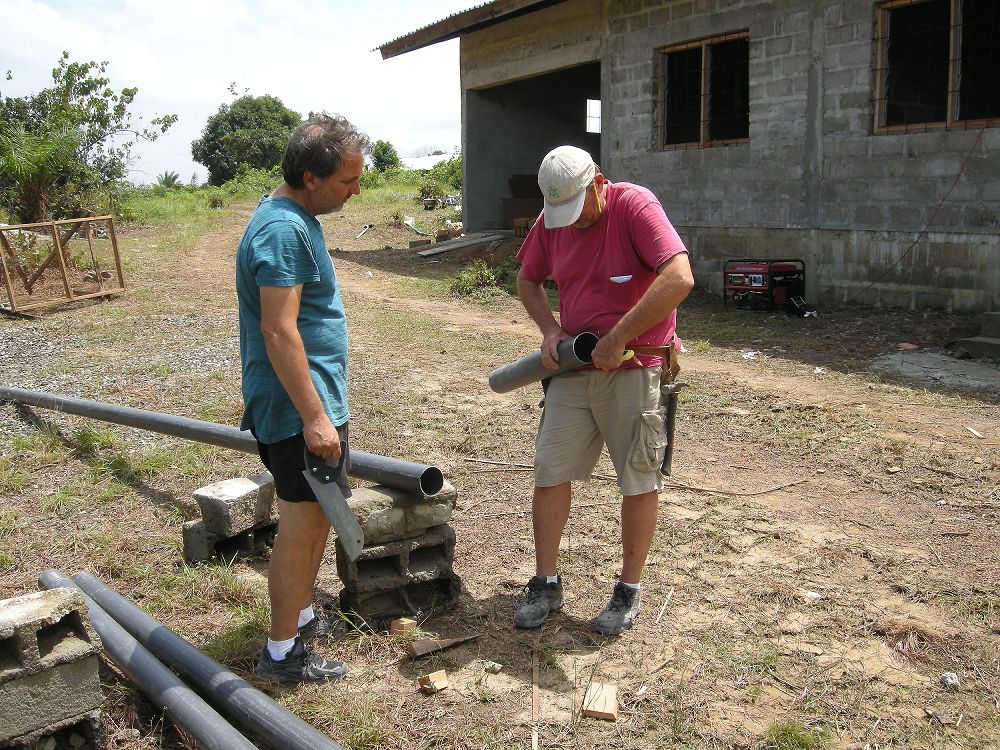
| Many different lengths of pipe would be needed, but Gordon Tiner (right)
had it all figured out. All Jim Purcaro would have to do was take his small
hand saw and cut the 20-ft lengths of PVC in all the right places and
as straight as possible! (I'm kidding, Jim... it was a big job and it did take you a long time to get it all done, out there in the hot sun!) |
 |
| Gordon
also said it was important to smooth off the raggedy cut ends of the pipes, so that later
they would fit together properly when we glued them together. |
 |
| So Jim measured each piece that was needed, ... |
 |
| ...sawed it, ... |
 |
| ...smoothed the cut end, ... |
 |
| ...and then explained to Prince why he was sure he had done it all exactly right! (Actually, I made that up... I have no idea what Jim was saying when I took this photo!) |
 |
| At the lavatory
building, the four drain units we had assembled earlier have already
been buried, one in each room. As you can see, there will be four
stalls in each room (with sinks on the opposite wall). |
 |
| The drains from
both front rooms needed to be routed to a central drain running out of
the building at the back, so Gordon started assembling the pieces. |
 |
| Then he applied the adhesive... |
 |
| ...and Flomo helped him force the pieces of pipe together. |
 |
| A long section of pipe was laid in place... |
 |
| ...and then it was forced a short distance out the back wall. |
 |
| Finally the drains from the two front rooms (behind me and the camera!) were connected to the long pipe leading to the exterior. |
 |
| Everything fit together perfectly! |
 |
| Gordon grabbed a level to check the pitch (slope) on the drain toward the outside... |
 |
| ...and that was looking good too! |
 |
| Each of the 16 toilet
drains, as well as the floor drain in the center of the breezeways,
needed to have a foot-long vertical extension pipe added to it, in order to bring
it above the level of the future floor slab. |
 |
| Here Jim is cutting
those extension pieces. Three of them have already been glued to the
toilet drains in the foreground, and the tops of these drain pipes have
been capped off temporarily with duct tape. |
 |
| Now Gordon has just glued the extension to the central floor drain. |
 |
| To make sure all the horizontal sections of pipe would maintain the correct slope toward the outside, soil was gently shoveled in underneath them to support them properly... |
 |
| ...and then the pipes were covered over with sand. |
 |
| Back in the 1980s, Edison (left)
was one of my students at Oceanview Christian School in River Cess.
Now he lives in Buchanan with his family. This afternoon, while we were
laying drainage pipes at the lavatory, he showed up with his two
sons and said that they had come out to the PROJECT BUCHANAN
work site to volunteer for a few hours, wherever they were needed.
Wow! They grabbed shovels and started digging a couple of ditches
that were needed for burying the side drains (one is seen here). During the following week, Edison came over in the evening to Gabriel's house where I
was staying, and we hung out doing stuff on our laptops. It was a great
time for us to reconnect! |
 |
| By the time I left
Buchanan in early August, this is how far the work on the lavatory
building had progressed: All the drains had been installed, the future 'washrooms'
and 'breezeways' had been filled in with dirt and leveled over, and a
pit for the school septic tank was almost finished (off to the right).
In the early dry season--perhaps in November--Flomo will cast the floor
slab. Hopefully when Gordon returns with another New Jersey team next
February, everything will be ready for him to supervise the building of
the walls. |
 |
| Looking east you can see the end of the PROJECT BUCHANAN
property where the peninsula juts out into the Benson River. But just
beyond the lavatory there is still enough level ground for another large
building--a great place for the chapel/auditorium. From here the view over the mangroves
is quiet and peaceful in every direction! |




.jpg "Flomo")
.jpg "Mixing cement for plaster")
.jpg "Mixing cement for plaster")
.jpg "Plastering the house interior")
.jpg "Scaffolding of blocks & boards")
.jpg "Wheelbarrow scaffold")
.jpg "Tow-Gaa")
.jpg "Plastering the back of the house 1")
.jpg "Plastering the back of the house 2")
.jpg "Plastering the back of the house 3")
.jpg "Plastering the back of the house 4")
.jpg "Plastering the back of the house 5")
.jpg "Lunch-time again 1")
.jpg "Lunch-time again 2")
.jpg "Lunch-time again 3")
.jpg "Plastering the front of the house")
.jpg "Unfinished plastering around a window")
.jpg "The finished plastering job around a window")
.jpg "Plastered wall, up close")
.jpg "Plastered house, and pit for septic tank")
.jpg "Pit for septic tank")
.jpg "Re-plumbing in 1st bathroom")
.jpg "Re-plumbing in 2nd bathroom")
.jpg "Tow-Gaa again")


.jpg)